What are the fees on issuing (Mint) and exchanging (Burn), and what are they for?
1.5625% on each operation. The protocol takes the Mint fee in coins and does not add it to the reserve, and takes the Burn fee in PRDX and does not burn it. Neither operation changes the PRDX price. The fees protect against arbitrage. The PRDX paid for a ticket burn when mining starts, and the payout is issued later, so between these moments the PRDX price is higher. Without fees, a participant could buy PRDX before someone else's ticket starts mining and sell before the payout is issued, and the price fall from the payout would land on those who hold PRDX. With the fees, a sale returns more coins than were put in on purchase only if the PRDX price growth between the purchase and the sale covers both fees.
How does PRDX differ from stablecoins?
A stablecoin's rate is pegged to the dollar or another currency. PRDX is backed by the reserve and can be exchanged for reserve coins at any time, but its price equals the reserve divided by the number of PRDX issued and grows on average while mining goes on. The PRDX price is expressed in the reserve coin, so against other currencies it moves together with that coin.
How is PRDX different from a pyramid scheme?
In a pyramid scheme old participants are paid with the money of new ones, and the payments stop when new ones stop coming. In PARADOX issuing PRDX for coins does not change the price, so new participants joining pays nobody by itself. Only the average shortfall on tickets raises the PRDX price, and miners give it up for a chance to mine many times more. If mining stops, the PRDX price stops growing but does not fall. All PRDX together are backed by the reserve and can be exchanged for reserve coins at any time at the same price.
Does PRDX need an exchange?
No: a participant issues PRDX by putting coins into the reserve and can exchange it back for reserve coins at any time. Both operations go at a price equal to the reserve divided by the number of PRDX issued. PRDX is still an ordinary token of its network: wallets show it, and it can be transferred.
Are TON, Solana and the reserve currencies connected?
No. On TON PRDX is issued for Gram or USDT, on Solana for SOL or USDT, and each of the four pairs works separately: it has its own PRDX, its own reserve, its own price and its own tickets. PRDX of one pair cannot be exchanged for PRDX of another.
Which standards are PRDX and tickets issued under?
On TON PRDX is issued under the Jetton standard (TEP-74), and a ticket as an NFT (TEP-62). The NFT's description records the ticket's level and state, and TON wallets show the ticket among other NFTs. On Solana PRDX is issued under the SPL Token standard. A ticket there is not an NFT: it is kept in a separate account of the protocol's program and can be transferred with a command of that program. On both chains a ticket can be transferred to another owner only before mining starts.
What is PRDX mining?
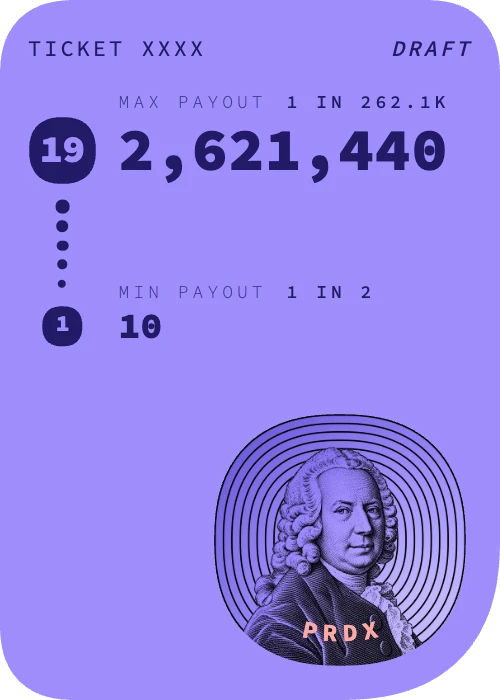
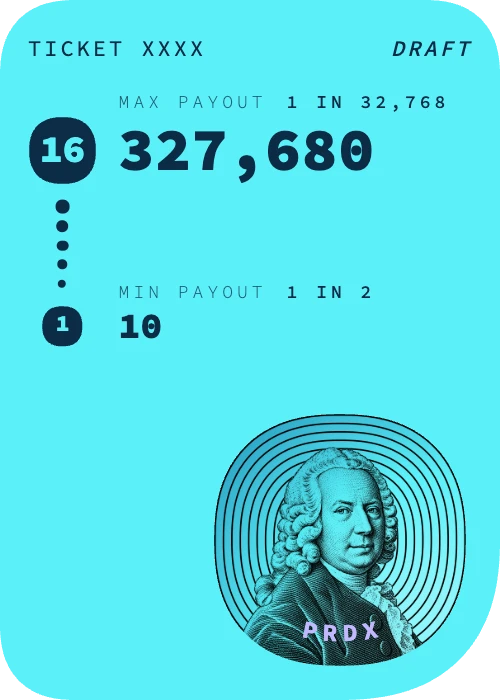
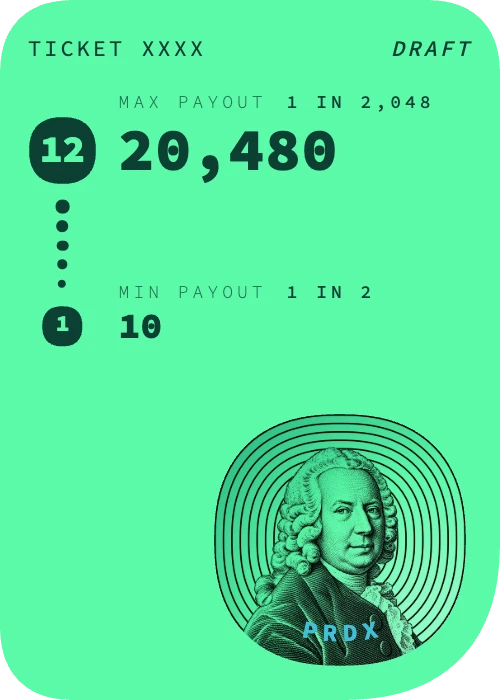
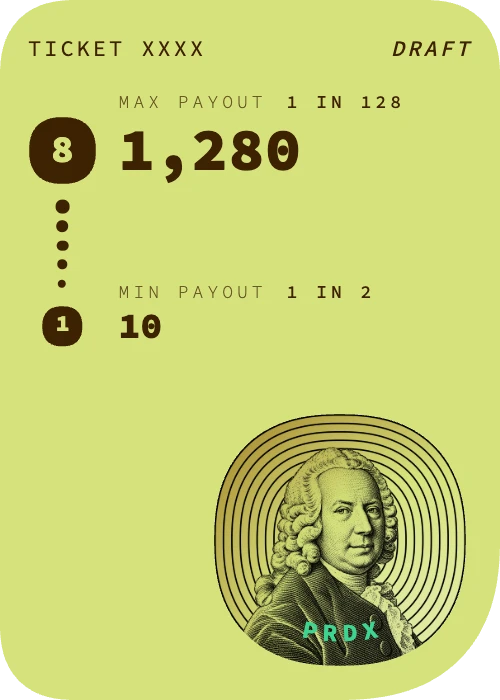
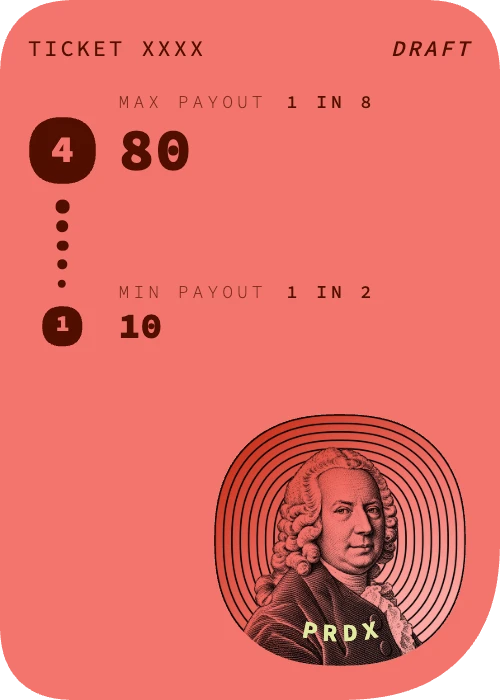
A ticket gives the right to mine PRDX. When mining starts, the PRDX paid for the ticket burn, and the protocol issues the payout as new PRDX. A ticket has three parameters: LVL from 2 to 32: the number of possible payouts. MIN from 1 PRDX: the smallest payout of one attempt. DRAWS from 1 to 8: the number of attempts. In each attempt a coin is tossed until heads, but no more than LVL − 1 times, and with each toss without heads the payout doubles. The average payout equals 87.5% of the ticket price for any parameters.
Who decides the payout, and where does the word “mining” come from?
No one chooses the payout: it is computed from the miner's random number (the secret) and the number of an independent service (the oracle). The protocol records the secret in hidden form before the oracle's number arrives. The miner can no longer change the secret, and the oracle sees only its hash. Both numbers are kept on the blockchain, and anyone can recompute the payout. The word “mining” comes from the similarity with Bitcoin: mining costs money, and the payout is random. Otherwise mining works differently: the chances are set by the ticket level, one ticket's payout does not depend on other tickets, and mining confirms no transactions.
Can you lose PRDX on mining?
Yes. On average a ticket returns 87.5% of its price, so the miner loses 12.5%. With one attempt on a high LVL the payout is most often below the ticket price and rarely many times above it: on LVL 24 the payout is below the ticket price in 15 cases out of 16, and the largest payout exceeds the price 587 thousand times.
How large can one ticket's payout be?
Up to 12.5% of all PRDX issued, that is, up to a ninth of the reserve in coins at the price after issuing. This limit grows with the number of PRDX issued: the more PRDX are issued, the larger the payout one ticket can bring. The limit protects those who hold PRDX: the protocol issues the payout as new PRDX, and a payout at the limit lowers their price by about 11%, not more. A ticket over the limit can be bought now and mined when there are more PRDX, or its level can be lowered (RESHAPE).
Can I change my mind after buying a ticket?
Yes, while mining has not started. A ticket can be canceled for exactly 87.5% of its price, and the other 12.5% burns. A ticket can also be given away or transferred to another address, and a ticket over the limit can be moved to a lower level (RESHAPE).
Can the PRDX price fall?
Yes. The protocol issues mined PRDX, so a large payout increases the number of PRDX at the same reserve, and the PRDX price falls; large payouts on several tickets at once lower it more. The fall from one payout is limited: about 11% at most. If mining goes on, such a fall is temporary: the number of PRDX shrinks again on average, and the PRDX price grows. In prdx-sim simulations with 100 to 100,000 participants the PRDX price fell in 1–4% of years.
Can anyone freeze or take my PRDX?
Not on the protocol's side. Governance cannot change PRDX balances and cannot pause Burn, so PRDX can always be exchanged for reserve coins. Governance can pause Mint, ticket purchases and the start of mining and change parameters for new tickets, while a ticket already bought keeps its share of the average payout. A USDT reserve carries an outside risk: USDT is issued by Tether, which can freeze USDT on any address, including the reserve's, for example at a regulator's request. Gram and SOL are the networks' own coins and cannot be frozen this way.
What are the protocol's risks?
The protocol is experimental and runs on test networks. On average a miner loses 12.5% of a ticket's price. After a large payout the PRDX price falls. The PRDX price grows only while mining goes on. The PRDX price is expressed in the reserve coin and moves against other currencies together with it. The issuer of USDT, Tether, can freeze a USDT reserve; a reserve in Gram or SOL has no such risk.